
The Cast
The people behind
the greatest stories.
Every character we animate walked out of scripture first. Here's who they were and what the Bible says about them — and every episode of their stories is one page away in the Library.

Books of Samuel · 1 Samuel 16–17
David
The shepherd boy whose sling felled a giant — and whose heart made him a king.
The youngest of eight brothers, David was tending sheep in Bethlehem when the prophet Samuel arrived with a horn of oil. God had rejected King Saul — and while everyone looked at the tall brothers, God looked at the heart. "Man looks at the outward appearance, but Yahweh looks at the heart" (1 Samuel 16:7).
When the Philistine champion Goliath defied the armies of Israel for forty days, it was this boy — too small for armor, armed with a sling and five smooth stones — who ran toward the giant that seasoned soldiers fled from. One stone was enough. David would go on to become Israel's greatest king, its sweetest psalmist, and an ancestor of Jesus.
Read the episodeAnimated film 70% in production · coming soon

Books of Samuel · 1 Samuel 17
Goliath
Nine feet of Philistine bronze, felled by faith and a single stone.
The champion of Gath stood over nine feet tall by the ancient measure — his coat of bronze armor alone weighed as much as a man. Morning and evening for forty days he strode into the valley of Elah and roared the same challenge: send one man to fight me, and let the loser's nation serve the winner. Not one soldier in Israel's army dared answer.
Goliath's story is the Bible's most vivid picture of how intimidation works — and how it fails. He mocked the boy who finally came out to meet him. But "the battle is Yahweh’s" (1 Samuel 17:47), and the giant who trusted in bronze fell to a shepherd who trusted in God.
Read the episodeAnimated film 70% in production · coming soon

Books of Samuel · 1 Samuel 1–2
Hannah
The mother whose desperate prayer was answered with a prophet.
Year after year Hannah went up to the temple at Shiloh carrying the same grief: she had no child, and her rival made sure she never forgot it. One evening she prayed so intensely — lips moving, no sound — that the priest Eli thought she was drunk. She was making a vow: give me a son, and I will give him back to You.
God remembered Hannah. She named her boy Samuel — "asked of God" — and kept her promise, bringing him to serve in the temple as soon as he was weaned. Her song of thanksgiving (1 Samuel 2) echoes a thousand years later in the song of Mary. The prophet who would anoint Israel's first two kings began as one woman's answered prayer.
Read the episodeAnimated film 70% in production · coming soon

Books of Samuel · 1 Samuel 1–16
Samuel
Asked of God — the prophet who made kings and answered to none of them.
He was the child of a desperate prayer, given back to God before he could walk. Samuel grew up in the temple at Shiloh, and one night a voice called his name in the dark — three times, until old Eli understood who was calling. "Speak; for your servant hears" (1 Samuel 3:10). From that night on, God let none of Samuel's words fall to the ground.
He became Israel's last judge and its maker of kings: the man who anointed Saul when the people demanded a crown, and who later carried a horn of oil to Bethlehem to anoint a shepherd boy nobody had thought to summon. His hardest lesson still cuts: "to obey is better than sacrifice" (1 Samuel 15:22).
The boy who heard God Give us a kingAnimated film 70% in production · coming soon

Books of Samuel · 1 Samuel 9–31
Saul
Israel's first king — head and shoulders above them all, and never at peace.
He was out looking for his father's lost donkeys when he found a kingdom instead. Tall, striking, "from his shoulders and upward he was higher than any of the people" (1 Samuel 9:2), Saul was everything Israel thought a king should look like — and on coronation day they found him hiding among the baggage.
His story is the Bible's great tragedy of a promising start: rash vows, an unlawful sacrifice made out of fear, a kingdom torn from him "this day" (1 Samuel 15:28). The same hands that once prophesied hurled a spear at the boy who played the harp to soothe him. Saul teaches what fear does to a man who stops listening.
Read the episodeAnimated film 70% in production · coming soon

Books of Samuel · 1 Samuel 18–20
Jonathan
"The soul of Jonathan was knit with the soul of David."
He was the king’s son and the kingdom’s heir, and the first time he met David after Goliath fell, something in him settled: “the soul of Jonathan was knit with the soul of David, and Jonathan loved him as his own soul” (1 Samuel 18:1). Then he did the thing no prince does — he took off his robe, his sword, his bow and his belt, and gave them to the shepherd who would take his throne (1 Samuel 18:4).
He warned David when his own father hunted him, spoke for him at the king’s table, and met him one last time among the trees to say it out loud: “you shall be king over Israel, and I shall be next to you” (1 Samuel 23:17). He died beside his father on Gilboa, and David’s lament has never been bettered: “your love to me was wonderful” (2 Samuel 1:26).
Read the episodeAnimated film 70% in production · coming soon

Book of Daniel · Daniel 1–12
Daniel
The exile who outlasted empires — and kept his windows open toward Jerusalem.
Carried to Babylon as a teenager, Daniel decided at the king's table that he would not defile himself — and spent the rest of a long life proving that quiet resolve outlasts loud power. He interpreted dreams no wise man could touch, telling the most feared king on earth: "there is a God in heaven who reveals secrets" (Daniel 2:28).
He served three kings and two empires without once serving their gods. As an old man, with a law signed against him, he went home, opened his windows toward Jerusalem, and prayed as he always had — three times a day (Daniel 6:10). The lions' den could not close a mouth God meant to keep speaking.
Ten times better The night among lionsAnimated film 40% in production · coming soon
Book of Daniel · Daniel 1–4
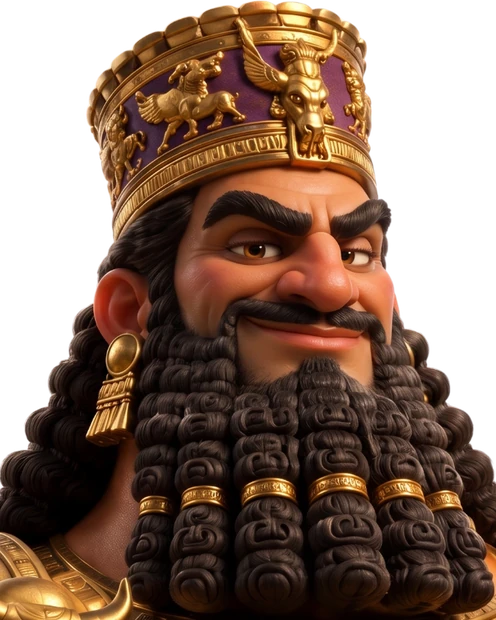
Nebuchadnezzar
The king who built golden Babylon — and learned who truly reigns.
The most powerful man on earth in his day, Nebuchadnezzar conquered Jerusalem, carried its brightest young men into exile, and built Babylon into a wonder of the ancient world. He dreamed dreams that terrified him, demanded the impossible of his wise men, and raised a golden image ninety feet tall — with a furnace ready for anyone who refused to bow.
Yet the book of Daniel shows this king being humbled step by step: by a dream only a captive could interpret, by three men who walked out of his furnace unburned, and finally by seven years of madness that ended with his eyes lifted to heaven. His own conclusion: "those who walk in pride he is able to abase" (Daniel 4:37).
The dream the king forgot The fourth man in the fire The king who ate grassAnimated film 40% in production · coming soon
Book of Daniel · Daniel 6
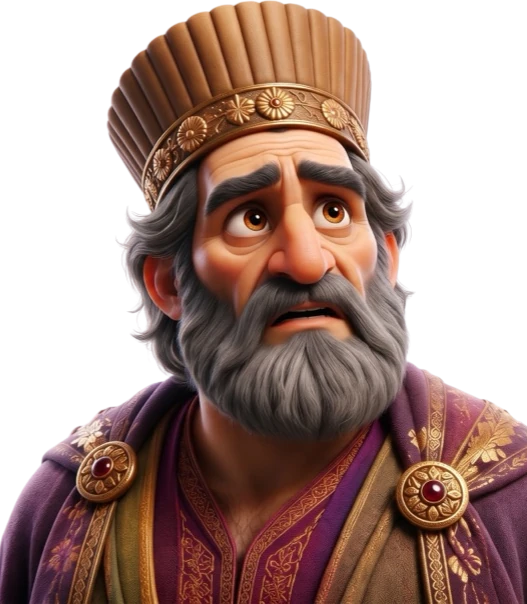
Darius
The Mede who sealed the lions' den — and could not sleep until dawn.
Darius the Mede inherited Babylon and quickly recognized the worth of an aging exile named Daniel — planning to set him over the whole kingdom. Jealous officials, unable to find any fault in Daniel, engineered a trap out of the king's own vanity: a decree that for thirty days, prayers could be made to no one but Darius himself.
The king signed, then discovered the law he could not unsign condemned the man he most trusted. He labored till sundown to save Daniel, sealed the den with his own signet, and spent the night fasting and sleepless. At first light he ran to the den and called out — and the answer that came back changed his kingdom: "My God has sent his angel, and has shut the lions' mouths" (Daniel 6:22).
Read the episodeAnimated film 40% in production · coming soon

Book of Daniel · Daniel 3
Shadrach
"But if not, we will not serve your gods."
Born Hananiah and renamed Shadrach in Babylon, he stood with Mishael and Azariah on the plain of Dura when the music played and a whole province went down on its face before a golden statue. The three of them stayed on their feet, and the king was told about it within the hour (Daniel 3:8–12).
Threatened with a furnace heated seven times hotter, they answered without hedging: our God is able to deliver us — “but if not, let it be known to you, O king, that we will not serve your gods” (Daniel 3:18). They walked out of the fire without so much as the smell of smoke on them, and a fourth figure had been walking with them.
Read the episodeAnimated film 40% in production · coming soon

Book of Daniel · Daniel 10–12
Michael
One of the chief princes — the one who stands for Israel.
When a shining messenger finally reaches Daniel by the great river after twenty-one days of unseen struggle, he names the one who came to his aid: "Michael, one of the chief princes" (Daniel 10:13). Michael is the contender — the archangel sent against powers no man can see.
Daniel is told how the story ends: "At that time Michael will stand up, the great prince who stands for the children of your people" (Daniel 12:1). Scripture shows him only briefly, and always in motion — arriving, contending, standing guard on the far side of the veil.
Read the episodeAnimated film 40% in production · coming soon

Book of Enoch · Genesis 5:21–24
Enoch
The man who walked with God — and was no more, for God took him.
Seven generations from Adam, in the long genealogy of Genesis where every life ends with the same words — "and he died" — one man breaks the pattern. "Enoch walked with God, and he was not found, for God took him" (Genesis 5:24). No death recorded. Just a walk that never ended.
The ancient Book of Enoch expands his story into one of scripture's most astonishing visions: the fallen angels called Watchers, their giant offspring, and Enoch himself carried through the heavens as a scribe and messenger between God and a world sliding toward the flood. His great-grandson was Noah — and the New Testament still quotes him by name (Jude 1:14).
Read the episodeAnimated film 80% in production · coming soon

Book of Enoch · Daniel 8–9 · Luke 1
Gabriel
The messenger who stands in the presence of God.
Only two angels are named in the Hebrew scriptures, and Gabriel is the one who brings the word. He interprets visions for Daniel by the river Ulai, is "caused to fly swiftly" to reach him "about the time of the evening offering" (Daniel 9:21), and in the Book of Enoch stands among the four great archangels before the throne, sent against the corruption of the Watchers.
Centuries later, the same messenger steps into a temple in Jerusalem and then a house in Nazareth, announcing the births of John the Baptist and of Jesus — introducing himself simply: "I am Gabriel, who stands in the presence of God" (Luke 1:19). When God has news that changes history, this is who carries it.
Animated film 80% in production · coming soon

Book of Enoch · Job 41 · Psalm 104
Leviathan
The untameable terror of the deep, stirred beneath the fifth day's seas.
"Can you draw out Leviathan with a fishhook?" God asks Job — and spends an entire chapter on the answer: no. Sparks leap from its mouth, its heart is hard as stone, iron is straw to it, and "on earth there is not his equal, that is made without fear" (Job 41:33). The sea monster is scripture's picture of everything in creation too vast for human hands.
Yet the psalmist adds a stunning twist: this same terror is God's creature, “whom you formed to play there” (Psalm 104:26). The Book of Enoch names Leviathan as the female monster of the watery abyss, set apart on the day of judgment. Untameable by us — never by its Maker.
Animated film 80% in production · coming soon

Books of Kings · 1 Kings 17 – 2 Kings 2
Elijah
The prophet of fire — fed by ravens, answered by lightning, carried home in a whirlwind.
He walked out of the wilderness in a garment of hair to tell King Ahab it would not rain again until he said so. Ravens brought him bread by a drying brook; a widow's last handful of flour refused to run out for him. On Mount Carmel he stood alone against four hundred fifty prophets of Baal and prayed one short prayer — and "the fire of Yahweh fell" (1 Kings 18:38).
Yet the Bible lets us see the man under the mantle: a day later he was under a broom tree asking to die. God answered not with more fire but with bread, sleep, and "a still small voice" (1 Kings 19:12). He left the earth the way he lived — in a storm, in a chariot of fire, his mantle falling to the one who watched him go.
The fire and the rain The still small voice The chariot of fireAnimated film 30% in production · coming soon

Books of Kings · 1 Kings 3–11
Solomon
The young king who asked God for a listening heart — and became a byword for wisdom.
When God appeared to the new king in a dream and said ask, Solomon did not ask for long life, riches, or the death of his enemies. He asked for "an understanding heart to judge your people" (1 Kings 3:9) — and got everything else thrown in. Two mothers, one living child, and a drawn sword made his wisdom famous overnight.
He built the temple his father David had only dreamed of, until the glory of the Lord filled the house and the priests could not stand to minister. The Queen of Sheba came to test him and left breathless: "the half was not told me" (1 Kings 10:7). And still his story carries a quiet warning — the wisest man in the world let his own heart drift, and a listening heart is kept, not just given.
Read the episodeAnimated film 30% in production · coming soon

Books of Kings · 1 Kings 19 · 2 Kings 2–13
Elisha
The farmer who burned his plow and followed.
Elijah found him plowing with twelve yoke of oxen and threw his mantle over his shoulders. Elisha slaughtered the oxen, cooked the meat on the wood of his own plow, gave it to his people, and followed (1 Kings 19:19–21). He left himself no way back — that was the point.
When the chariot of fire took his master, Elisha picked up the fallen mantle and struck the water: “Where is Yahweh, the God of Elijah?” The river parted for him too. A double portion, the company of prophets said — and the stories that follow him are full of it: axe-heads that float, a healed enemy general, a widow's oil that would not run out.
Read the episodeAnimated film 30% in production · coming soon

Books of Kings · 1 Kings 10
The Queen of Sheba
"The half was not told me."
She came from the ends of the known world with camels bearing spices, gold and hard questions — a head of state traveling months to see for herself whether the reports about Solomon could possibly be true (1 Kings 10:1–3). He answered everything she asked.
When she had seen the house he built, the food on his table, and the way his servants stood, "there was no more spirit in her." Her verdict has outlived every empire involved: "The half was not told me" (1 Kings 10:7).
Read the episodeAnimated film 30% in production · coming soon

Books of Kings · 1 Kings 17
Widow of Zarephath
"The jar of meal didn’t empty."
Elijah found her at the town gate gathering sticks, and asked her for water and a piece of bread. She had a handful of meal in a jar and a little oil in a jug — enough for one last meal for herself and her son, and after that, she said plainly, they would die (1 Kings 17:10–12).
She made the prophet’s cake first. The jar of meal did not empty and the jug of oil did not fail, all through the famine (1 Kings 17:16). Later, when her son stopped breathing, Elijah carried him upstairs and gave him back alive — and she said, “Now I know that you are a man of God.”
Read the episodeAnimated film 30% in production · coming soon

Book of Jonah
Jonah
The prophet who ran from mercy — and was carried back by the sea.
Told to go east to Nineveh, Jonah bought a ticket west and sailed for the edge of the map. The storm that followed did not scare him as much as the message did: he knew exactly who God was — "gracious, and merciful, slow to anger" (Jonah 4:2) — and he did not want that mercy wasted on his enemies. Thrown overboard at his own request, he was swallowed by a great fish God had prepared, and prayed from the belly of it.
Three days later the reluctant prophet walked into the greatest city of his age with an eight-word sermon, and the unthinkable happened: Nineveh listened. The book ends not with Jonah's triumph but with God's question to a sulking man under a withered vine — shouldn't I care for a city of a hundred twenty thousand? Mercy gets the last word.
Read the episodeAnimated film 30% in production · coming soon

Book of Jonah · Jonah 1–2
The Great Fish
The Lord appointed a great fish.
It is the most matter-of-fact line in the book: “Yahweh prepared a great fish to swallow up Jonah” (Jonah 1:17). Not a monster, and not a punishment — an appointment. The storm was the sea saying no; the fish is God saying not yet.
For three days and three nights it carried its passenger through the deep, down past the roots of the mountains, until the prayer finally rose. Then the fish did the last thing it had been appointed to do, and set the prophet back on dry land.
Read the episodeAnimated film 30% in production · coming soon

Book of Revelation · Revelation 1
John of Patmos
The exile on a prison island — to whom heaven opened its final book.
An old man banished to a rock in the Aegean "for the word of God" (Revelation 1:9), John heard a voice behind him like a trumpet on the Lord's day. He turned — and saw the risen Jesus standing among seven golden lampstands, eyes like flame, face like the sun. John fell at his feet as one dead, and felt a hand on his shoulder: "Don't be afraid. I am the first and the last" (Revelation 1:17).
What he was shown next fills the Bible's final book: thrones and seals, a Lamb standing as though slain, a dragon at war with heaven, and at last a city coming down like a bride. To an exile on an island, God entrusted the promise the whole story bends toward: "Behold, I am making all things new" (Revelation 21:5).
Read the episodeAnimated film 30% in production · coming soon

Book of Revelation · Revelation 12
Great Red Dragon
"There was war in heaven."
John saw a second sign in the sky: an enormous red dragon, many-headed and crowned, its tail dragging a third of the stars down with it (Revelation 12:3–4). It took its place in front of the woman who was about to give birth, waiting to devour her child the moment it was born.
Then Michael and his angels fought it, and it lost its place in heaven — “the old serpent, he who is called the devil and Satan” thrown down to the earth (Revelation 12:7–9). Beaten above, it turns on the woman and on everyone who keeps God’s commandments, “having great wrath, knowing that he has but a short time” (Revelation 12:12).
Read the episodeAnimated film 30% in production · coming soon

Book of Revelation · Revelation 12
Woman Clothed with the Sun
"A great sign was seen in heaven."
She appears wearing the sun, standing on the moon, with a crown of twelve stars on her head — and she is in labor, crying out in pain to give birth (Revelation 12:1–2). The dragon waits in front of her, and her son is caught up to God and to his throne.
Then she is carried into the wilderness, to a place God prepared for her, and kept there (Revelation 12:6). The dragon pours a river out of its mouth to sweep her away, and the earth opens and swallows the flood. She is the one thing in the vision the dragon cannot reach.
Read the episodeAnimated film 30% in production · coming soon
Every face here has an episode in the Library.
Pick a character above, or browse the whole shelf book by book.